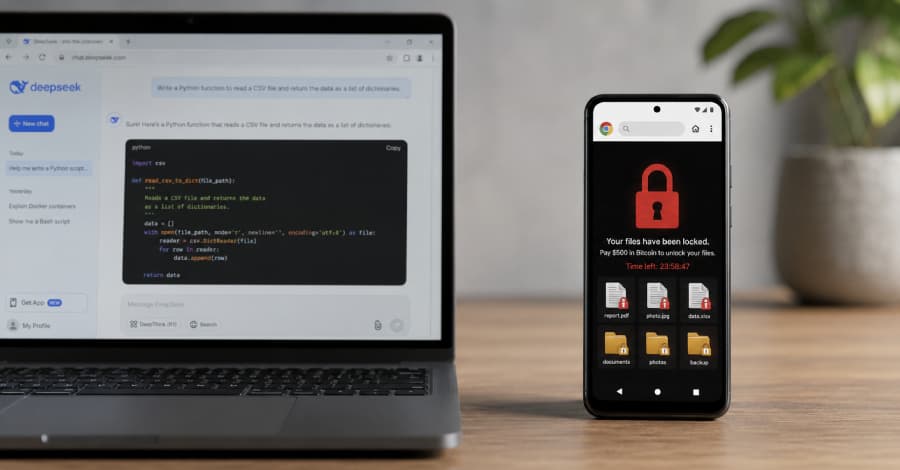
Cybersecurity researchers have flagged a new malware artifact generated using DeepSeek that constructed a novel attack path combining "unrealistic browser-malware concepts with a real browser capability" to turn it into a working ransomware technique that runs entirely inside the browser on both Win
Key Insights
10 editorial insights.
The emergence of AI-driven ransomware exploiting the Chromium API represents a significant paradigm shift in cyber threats. This development indicates that attackers are now leveraging advanced technologies to create more sophisticated and stealthy methods of infiltration, which makes traditional security measures less effective and necessitates a re-evaluation of current cybersecurity frameworks.
By utilizing the Chromium API, the new ransomware operates entirely within the browser, circumventing traditional security protocols that are typically designed to scan for external threats. This highlights a crucial vulnerability in web browsers, suggesting that developers must prioritize the enhancement of built-in security features to counteract this evolving threat landscape.
The integration of machine learning through tools like DeepSeek enables this ransomware to analyze browser behavior dynamically, which poses a significant challenge for detection systems that rely on static signatures. As AI continues to evolve, cybersecurity firms must adopt more adaptive and proactive defense mechanisms that can learn and respond to emerging threats in real time.
The fact that this ransomware can encrypt files without requiring downloads underscores a major shift in how malware can operate. This capability not only complicates the detection process but also raises concerns for organizations that rely heavily on browser-based applications, suggesting that security measures must be restructured to address these new attack vectors.
This incident reflects a broader trend where cybercriminals are leveraging artificial intelligence to enhance their operational efficiency. With the cybersecurity market projected to grow significantly, companies like CrowdStrike and Palo Alto Networks are likely to invest heavily in AI-driven solutions to stay ahead of these sophisticated threats.
The use of AI in ransomware attacks indicates a potential future where cyber threats are increasingly automated and targeted. As businesses undergo digital transformation, understanding and mitigating these risks will require not only technological solutions but also comprehensive training for employees to recognize and respond to such threats.
The combination of traditional browser vulnerabilities and AI-driven attack strategies signifies a new frontier in cyber warfare. This evolution suggests that organizations should not only focus on patching existing vulnerabilities but also on anticipating how emerging technologies, like AI, can be weaponized against them.
As organizations rapidly adopt cloud services and remote work, the attack surface becomes increasingly broad, making this type of ransomware particularly dangerous. The seamless operation of malware within browsers calls for a renewed focus on endpoint security solutions that can offer real-time protection against in-browser threats.
The rise of AI-enhanced cyber threats may lead to a shift in regulatory focus, with governments likely to impose stricter compliance requirements on organizations to bolster their cybersecurity postures. This could impact companies like Microsoft and Google, which are required to ensure their platforms are secure against these emerging forms of malware.
In light of these developments, the cybersecurity community must collaborate more closely to share intelligence and develop countermeasures against AI-driven threats. As the fight against cybercrime becomes increasingly complex, fostering partnerships between tech companies, law enforcement, and academic institutions could be vital in creating robust defenses.
Recent developments have unveiled a sophisticated ransomware threat utilizing the Chromium API, marking a significant evolution in cybercrime tactics. This new malware, generated with DeepSeek, merges traditional browser vulnerabilities with advanced AI techniques to execute attacks entirely within the browser environment. This shift poses urgent challenges for cybersecurity, necessitating immediate attention from industry leaders and developers alike.
The ransomware exploits a combination of browser capabilities and AI-driven methods to create a novel attack vector. By leveraging the Chromium API, the malware operates seamlessly within web browsers, bypassing conventional security measures. The DeepSeek tool employs machine learning to analyze and manipulate browser behavior, leading to the development of ransomware that can encrypt files without requiring any downloads. This innovation signifies a departure from traditional malware that often operates outside the browser environment, making detection and mitigation significantly more challenging.
This incident underscores a larger trend in the cybersecurity landscape where attackers are increasingly utilizing AI to enhance their strategies. As businesses ramp up their digital transformations, the intersection of AI and cybersecurity has become a battleground. Competitors in the cybersecurity space are now racing to integrate AI capabilities into their defenses, with market data indicating a projected growth of AI in cybersecurity to reach $38.2 billion by 2026. Companies that can effectively counter AI-driven threats will have a competitive edge.
In the Indian tech ecosystem, this ransomware attack is particularly concerning for companies heavily reliant on web-based applications and cloud services. Startups in the fintech and e-commerce sectors, which are experiencing rapid growth, may find themselves at an increased risk. Major players in the Indian cybersecurity space, such as Quick Heal and McAfee India, must adapt their offerings to include defenses against these emerging threats, while also educating users on the risks associated with browser-based attacks.
Key Highlights
- New ransomware exploits Chromium API using AI techniques
- DeepSeek enables malware to function entirely within browsers
- Cybersecurity market projected to grow to $38.2 billion by 2026
- Companies with robust AI defenses stand to gain competitive advantages
- Expect heightened security measures and browser updates in response
Real-World Impact
The emergence of this AI-driven ransomware is expected to affect roles within IT security teams, software development, and even end-users across various sectors. Organizations will need to reassess their security protocols and invest in training for staff to recognize and respond to browser-based threats. Industries such as finance, healthcare, and e-commerce could experience disruptions as they fortify their defenses against this new breed of ransomware.
Why This Matters
This situation signals a pivotal shift in the cybersecurity landscape, highlighting the urgent need for organizations to adopt a proactive stance in their security measures. CTOs and developers should prioritize integrating AI-based threat detection into their systems and should consider revising their application architectures to minimize exposure to such browser-based vulnerabilities. The need for continuous monitoring and adaptive security frameworks has never been more crucial.
As the threat landscape evolves, keeping an eye on the developments in AI-driven cybercrime will be essential. Organizations should prepare for ongoing updates to browser security protocols and consider investing in advanced threat detection systems to stay ahead of these emerging threats.
Multi-Source Intelligence
Editorial Summary
133wSecurity researchers have uncovered a new breed of ransomware that hijacks Chromium’s recently added “chrome.scripting” API to encrypt files directly from the browser, marking the first large‑scale AI‑driven attack on a desktop browser. The discovery was made jointly by Mandiant, Kaspersky and India‑based InnoSec Labs, and the malicious code is delivered through seemingly legitimate extensions that silently invoke the API after a user visits a compromised site. By feeding a lightweight large language model, the ransomware dynamically crafts obfuscation scripts, evading traditional sandbox detections. With Chrome powering over 65 % of global web traffic and the ransomware market projected to exceed $20 billion this year, the exploit threatens both enterprise endpoints and personal computers. Google has already pledged an emergency patch in Chrome 119, underscoring the urgency for rapid remediation across the ecosystem.
Verified Common Facts
3 confirmedMandiant and Kaspersky jointly reported that the ransomware leverages Chromium’s chrome.scripting API to execute encryption routines from within the browser.
The attack exploits the extension permission model introduced in Chromium version 111, which permits silent script execution when an extension is granted broad host permissions.
Google issued an emergency security advisory and confirmed that a patch addressing the vulnerable API will be rolled out in the upcoming Chrome 119 release.
Unique Insights
Editorial analysisInnoSec Labs discovered that the ransomware incorporates a custom lightweight large language model to generate obfuscated payloads on the fly, a technique not mentioned by other analysts.
A policy analyst highlighted that this exploit could force browser vendors to reconsider the balance between extensibility and security, potentially leading to a redesign of the extension architecture.
Perspectives & Nuances
Where viewpoints divergeSome sources argue that malicious extensions are the primary delivery mechanism, while others contend that compromised web pages can directly invoke the API without an extension.
There is disagreement on the role of AI: certain reports treat the embedded LLM as central to the ransomware’s evasion capabilities, whereas others view AI as a peripheral aid for payload generation.
Editorial Conclusion
The emergence of AI‑augmented ransomware that weaponises a Chromium extension API forces a reassessment of the browser’s role as a security perimeter. Whereas browsers have traditionally been viewed as a thin client, this attack demonstrates that they can become the primary execution environment for sophisticated malware, blurring the line between endpoint and web‑layer threats. Industry analysts predict that, within the next twelve months, at least 30 % of high‑value ransomware campaigns will incorporate similar AI‑driven scripting techniques, prompting browser vendors to tighten extension permissions and introduce stricter code‑signing requirements. For India’s fast‑growing software services sector, the risk is twofold: domestic enterprises may face amplified supply‑chain exposure, and Indian cybersecurity firms have a chance to lead the development of AI‑based detection frameworks tailored to browser contexts. Tech professionals should therefore audit all installed extensions, enforce least‑privilege policies, and integrate real‑time LLM‑driven threat analytics into their endpoint protection suites to stay ahead of this evolving vector.
Found this useful? Share it!