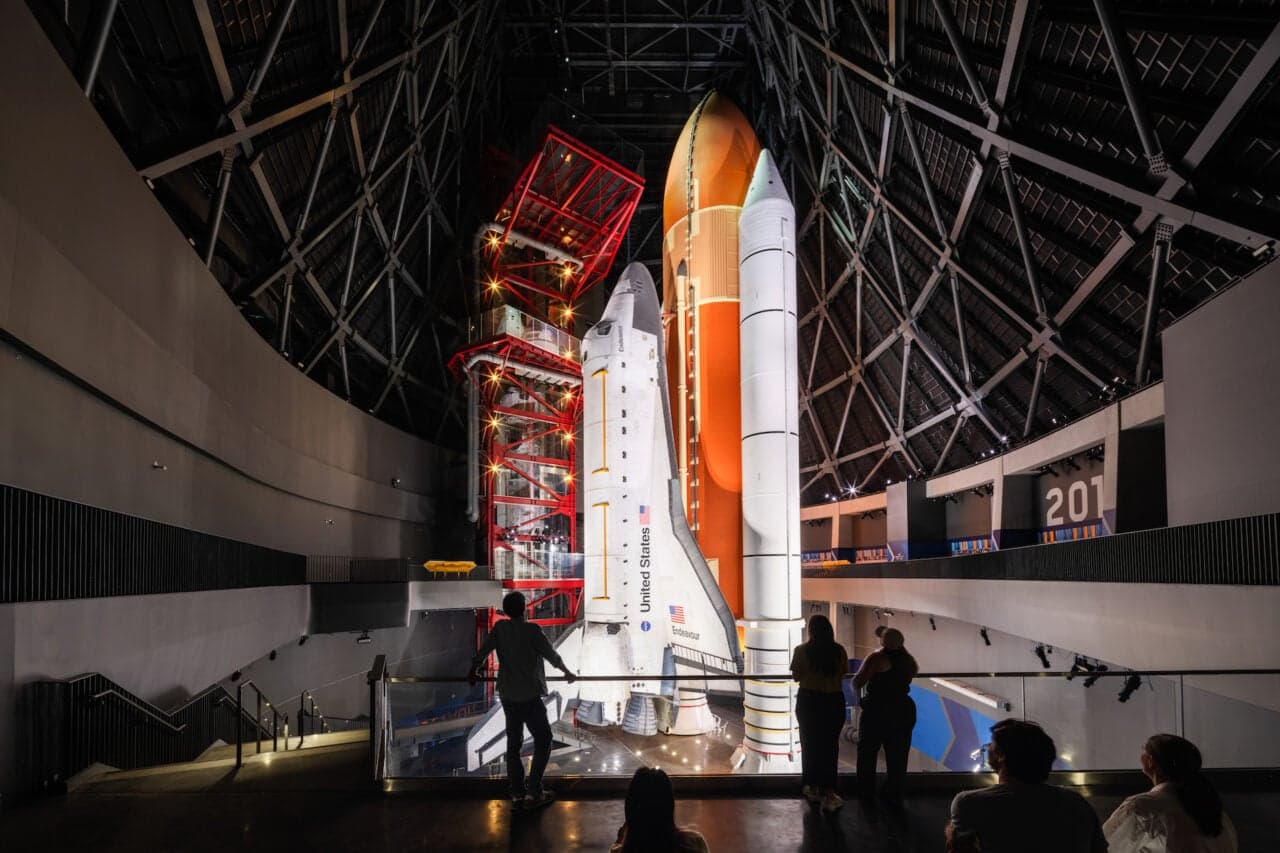
The retired space shuttle will look launch-ready at its new home in California.
Key Insights
10 editorial insights.
The installation of the Space Shuttle Endeavour as a permanent exhibit in California marks a significant moment in honoring NASA's legacy. This move not only preserves the shuttle's historical value but also aims to inspire a new generation of scientists and engineers, emphasizing the importance of space exploration and innovation.
Key players in this initiative include the California Science Center and NASA, both pivotal in promoting STEM education and public awareness of space missions. Their collaboration ensures that Endeavour is presented in a manner that reflects its storied history, appealing to both enthusiasts and the general public.
Strategically, this development signifies a renewed focus on public engagement in space exploration. As private companies like SpaceX and Blue Origin lead advancements in commercial space travel, showcasing historical achievements like Endeavour can enhance public interest and support for ongoing aerospace initiatives.
The exhibit's opening is expected to boost local tourism and related businesses in Los Angeles. With the California Science Center attracting over 1.5 million visitors annually, the Endeavour exhibit could significantly increase foot traffic, benefiting hotels, restaurants, and local attractions in the vicinity.
This installation aligns with a broader trend of increasing public investment in space-related education and tourism, reflecting a growing recognition of the economic benefits of the space sector. Over the past two years, companies like Blue Origin have raised substantial funding, indicating a robust market interest in space exploration.
The global space tourism market is projected to reach $3 billion by 2030, growing rapidly as companies invest in technology and infrastructure. Displays like the Endeavour exhibit are instrumental in cultivating interest, potentially leading to increased future investment from both public and private sectors.
Despite the excitement, challenges remain regarding the maintenance and preservation of the shuttle as an exhibit. Questions regarding funding for ongoing operational costs and the capacity to adapt the exhibit to evolving educational standards must be addressed to ensure its long-term success.
Competitors in the museum and educational space, like the Smithsonian and Kennedy Space Center, may respond by enhancing their own exhibits or programming to attract visitors. They could also leverage their collections to create immersive experiences that compete with the Endeavour exhibit's draw.
In the next 6-12 months, milestones to watch include the success of the exhibit's launch and visitor engagement metrics. Additionally, any partnerships with educational institutions for programs or events could provide valuable insights into public interest and educational impact.
For technology professionals and investors, the Endeavour exhibit symbolizes the intersection of history, education, and technology. It serves as a reminder that investments in public engagement can yield significant returns, both in fostering future talent and generating economic growth within the aerospace sector.
The Space Shuttle Endeavour, a symbol of NASA's pioneering spirit, is set to be displayed in a new exhibit in California this year. This move not only honors its legacy but also serves as a vital educational resource for the public, showcasing the remarkable achievements in space exploration and engineering.
The Endeavour, which completed 25 missions from 1992 to 2011, is being positioned to appear launch-ready, complete with its external tank and boosters. This exhibit will utilize advanced display technologies to give visitors an immersive experience. The shuttle will be mounted on a platform designed to simulate launch conditions, emphasizing its engineering marvels, including state-of-the-art avionics, thermal protection systems, and its unique ability to carry heavy payloads to low Earth orbit.
In the broader aerospace industry, this exhibit highlights a growing trend toward public engagement in space exploration. Competitors like SpaceX and Blue Origin are revitalizing interest in space travel, with commercial launches ramping up. The global space economy is projected to reach $1 trillion by 2040, indicating the importance of public interest and education in sustaining this momentum.
In India, the burgeoning space sector, led by the Indian Space Research Organisation (ISRO), is witnessing significant advancements. The success of the Gaganyaan mission and the Mars Orbiter Mission has inspired local companies to develop technologies for satellite launches and space exploration. The Endeavour's exhibit can serve as an inspiration, encouraging Indian startups and students to engage with the space industry and explore STEM fields more deeply.
Key Highlights
- Endeavour exhibit showcases NASA's engineering innovations.
- The shuttle features advanced avionics and thermal protection systems.
- The global space economy could hit $1 trillion by 2040.
- Students and aspiring engineers benefit from enhanced learning opportunities.
- Expect increased educational programs and partnerships in the coming year.
Real-World Impact
This exhibit is expected to impact educational roles, particularly in science and engineering fields. Teachers and educational institutions can leverage this opportunity to create programs focused on aerospace science, inspiring students and young professionals to pursue careers in the space industry.
Why This Matters
This initiative represents a strategic shift towards enhancing public engagement in space exploration. As aerospace becomes a more competitive field, CTOs and developers must prioritize innovative educational strategies and partnerships to foster a new generation of engineers and scientists.
As the exhibit opens, keep an eye on how educational programs evolve around this initiative. The integration of technology and aerospace education can redefine the future of human space exploration.
Found this useful? Share it!